
Trek Overview
The Machame route, also called the “Whiskey” route, is the most popular way to climb Kilimanjaro. Its appeal lies in its scenic views. However, the trail is considered tough, steep, and challenging, especially because of its shorter itinerary. This makes the route better suited for more adventurous travelers or those with some experience in high-altitude hiking or backpacking.
The route starts from the south, beginning with a quick drive from Moshi to Machame Gate. It then leads hikers through rain forest to the Shira Plateau, where many of Kilimanjaro’s routes meet. Next, it turns east and crosses beneath Kilimanjaro’s Southern Ice Field along a path called the Southern Circuit before reaching the summit from Barafu. The descent is via the Mweka route.
Day-to-Day Itinerary
Day 1: Machame Gate (1,800m) to Machame Camp (3,000m)
After breakfast, you’ll be driven from Moshi to the Machame Gate. Here, you will complete registration formalities, and your trekking permits will be checked. The trek begins through dense rainforest, a lush, green environment with towering trees, ferns, and possibly some wildlife like colobus monkeys. The trail can be muddy and slippery, so trekking poles are useful. After 5-7 hours of trekking, you will reach Machame Camp, where you’ll have dinner and overnight.
- Distance: 11 km (7 miles)
- Hiking Time: 5-7 hours
- Habitat: Rainforest
DAY 2: Machame Camp (3,000m) to Shira Camp (3,840m)
After breakfast, the trek continues with a steep climb out of the rainforest and into the heather and moorland zone. The landscape opens up, offering spectacular views of Mount Meru, Shira Plateau, and Kibo Peak. The trail becomes rocky and dusty, with giant heather plants and volcanic rock formations. Upon reaching Shira Camp, you can enjoy panoramic views of the plateau and surrounding valleys. The temperatures here are significantly cooler, especially at night. Dinner will be served at camp before you rest for the evening.
- Distance: 5 km (3 miles)
- Hiking Time: 4-6 hours
- Habitat: Moorland
DAY 3: Shira Camp (3,840m) to Barranco Camp (3,950m)
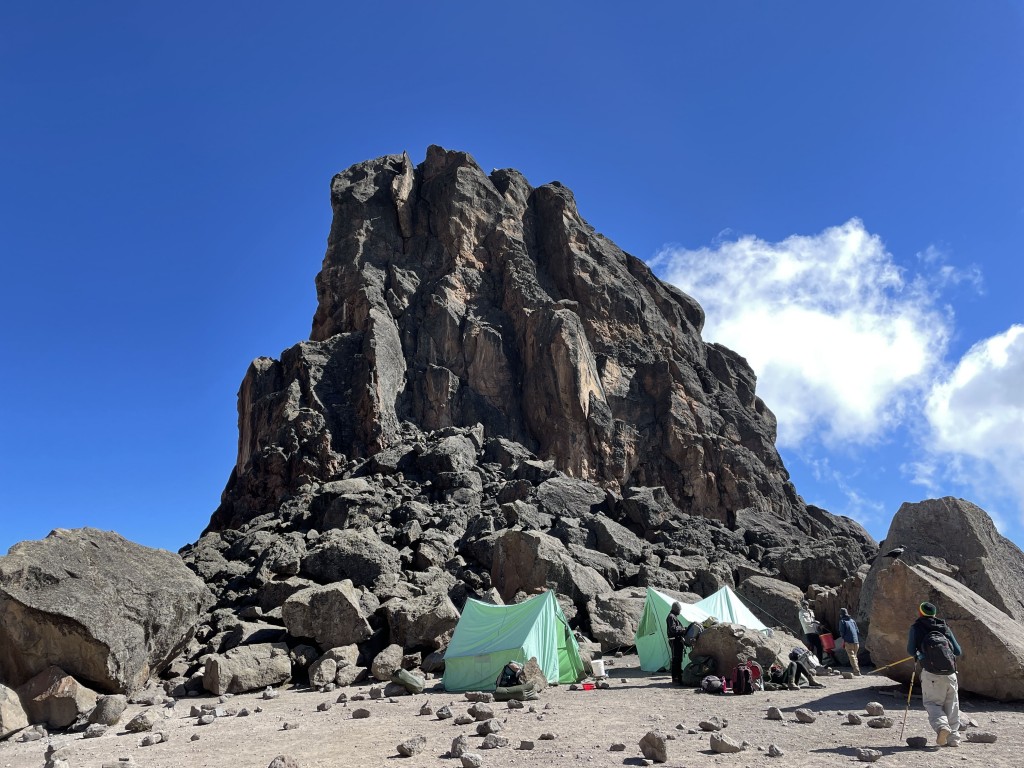
The day starts with a gradual ascent toward Lava Tower, a 4,630-meter-high volcanic rock formation. This is a significant acclimatization day as you reach a higher altitude than where you’ll sleep. The landscape becomes more barren as you enter the alpine desert, with only small shrubs and hardy plants surviving the harsh conditions. After lunch near Lava Tower, you’ll descend into the Barranco Valley, which brings you to Barranco Camp. The descent helps with acclimatization and prepares you for the upcoming challenges.
- Distance: 10 km (6 miles)
- Hiking Time: 6-8 hours
- Habitat: Semi-desert
DAY 4: Barranco Camp (3,950m) to Karanga Camp (3,995m)
The day begins with the challenging climb of the Barranco Wall, a steep, rocky slope that requires some scrambling. Although the wall may look intimidating, the trail is manageable and offers breathtaking views as you climb. After successfully conquering the Barranco Wall, the trail follows a series of ridges and valleys, with occasional descents and ascents. The landscape remains arid, with scattered boulders and views of the southern glaciers. You’ll reach Karanga Camp in the early afternoon, giving you time to rest, acclimatize, and prepare for the higher altitudes to come.
- Distance: 5 km (3 miles)
- Hiking Time: 4-5 hours
- Habitat: Alpine Desert
DAY 5: Karanga Camp (3,995m) to Barafu Camp (4,673m)
The trail to Barafu Camp is a steady ascent over rocky and barren terrain, with little vegetation. As you approach Barafu Camp, the terrain becomes steeper and more rugged. The camp is located on a rocky ridge, with breathtaking views of Mawenzi Peak and the summit of Kibo. You’ll arrive at Barafu Camp in the early afternoon. This is your base camp for the summit attempt, so after an early dinner, you’ll rest and prepare for the final ascent.
- Distance: 4 km (2.5 miles)
- Hiking Time: 4-5 hours
- Habitat: Alpine Desert
DAY 6: Barafu Camp to Uhuru Peak (5,895m) to Mweka Camp (3,100m)
The summit attempt begins around midnight. With headlamps lighting the way, you’ll begin the challenging climb up steep scree and ice slopes. The climb to Stella Point is the most physically demanding part of the journey. Upon reaching Stella Point at sunrise, you’ll take a short rest and then continue along the crater rim to Uhuru Peak, the highest point on Kilimanjaro and in Africa. After celebrating at Uhuru Peak, you’ll descend back to Barafu Camp for a brief rest, and then continue the descent to Mweka Camp.
- Distance: 5 km (3 miles) ascent to Uhuru Peak + 12 km (7.5 miles) descent to Mweka Camp
- Hiking Time: 7-8 hours to the summit, 4-6 hours descent to Mweka Camp
- Habitat: Arctic to Rainforest
DAY 7: Mweka Camp (3,100m) to Mweka Gate (1,640m)
On the final day, you’ll continue descending through the rainforest to Mweka Gate. The trail is gentle and surrounded by the sounds and sights of the forest, a stark contrast to the barren summit. At Mweka Gate, you’ll complete park formalities and receive your summit certificates. After celebrating with your guides and porters, you’ll be driven back to Moshi, where you can enjoy a well-deserved rest.
- Distance: 10 km (6 miles)
- Hiking Time: 3-4 hours
- Habitat: Rainforest
Best Time to Use the Route
The best time to climb Kilimanjaro via the Machame Route is January to March and June to October. These months offer clear skies and stable weather. You can still climb during the short rainy seasons, but expect more mud, clouds, and possible snow.
Route at a Glance
Trek Duration;
7 Days, 6 Nights
Scenery;
Excellent
Difficulty;
Medium
Traffic;
High
Route Highlights
- One of the most scenic and popular Kilimanjaro routes
- Good acclimatization with steady altitude gains
- Beautiful views from Shira Plateau and Lava Tower
- Strong summit success rate with the 6-day plan
- Stunning sunrise summit attempt from Barafu Camp
Detailed Breakdown
Trekking Cost Includes
- All entrance fees and Government Taxes
- Airport Transfers (upon Arrival and Departure)
- Clean, purified drinking water
- Fair wages for the mountain crew.
- All meals while on the Mountain
- Rescue Fees and all taxes.
- Salaries for Porters, Cook, and Guides
- Oxygen Tanks, Pulse Oximeter, and First Aid Kit
- Private cook speaking fluent English
- Private guide speaking fluent English
- Transfers from the Hotel to the Kilimanjaro entrance gate and from the Kilimanjaro exit gate to the hotel.
Trekking Cost Excludes
- Travel insurance
- Tips for guides, porters, and cooks.
- Accommodation on day of arrival and departure.
- Visas & vaccinations.
- Personal expenses eg. Laundry, beverages, etc.
- Bed, Sleeping Bag, and walking Poles.
- Private Toilet and hot shower tent.
- International flights (can be booked for you on request)
Inquiry Space
TRAVEL WITH DEO SAFARIS
#travelwithdeosafaris
Verified Fantastisk We went on a two-day safari. On the first day, we were in the national park and had an excellent guided tour by Am Abdallah and Muhidini. They were very knowledgeable, explained things well, and drove in a way that allowed us to see the animals up close. On the second day, we visited the Maasai people, where we received a very good introduction and learned about how they live. After that, we went on a boat safari, which was perfect for seeing the hippos up close. All in all, this was an amazing experience with excellent service.Posted on TripadvisorVerified An amazing two-day safari experience Thank you Abdullah for showing us around the national park and caring about us for almost full two days! Your knowledge about this and other places is fantastic and answers to our many questions are highly appreciated. And the team of you and the driver Muhidini was truly great, the experience we got exceeded our biggest expectations as we saw much more wild animals than we could dream of. Once again - thank you very much and we hope many more travellers will get a chance to be guided by you.Posted on TripadvisorVerified Es war ein Traum Hatte zwei unvergessliche Tage im Nyerere Nationalpark mit Travel with Deo Safari.Der Transfer verlief Reibungslos alles war perfekt durch Organisiert.Mein Guide Abdullah und Fahrer Mutideni begleiteten mich durch die Atemberaubende Natur und Tierwelt ,diese vielen Tiere aus der Nähe zusehen war ein Traum. Sie bereiteten ein Frühstück in der Wildnis am See vor.Mutideni hatte selbst gemachte Reiscaks ,die waren so lecker. Am Abend ging es in die Selous Safari Lodge,dort Empfang mich Maria herzlich . Bungalow waren riesig alles perfekt und Essen lecker. Nächsten Tag begrüßte mich Goodluk,wir besuchten ein Massai Dorf,mir wurde viel über das Leben der Massai erklärt und führten mich durch das Dorf.Es war sehr interessant,im Anschluss hatte ich eine Bootstour auf dem Rufiji Fluss mit einem erfahrenen jungen lokalen Guide,beobachten viele Vögel , Flusspferde und Krokodile.Ich kann diese zwei Tagestour von Travel with Deo Safari nur empfehlen ,sehr Erlebnis reich und entspannend ASANTE SANA ,Danke schön Abdullah,Mutideni und Goodluk Super erfahrene GuidesPosted on TripadvisorVerified Great experience Excellente experience en couple on recommande a fond ! Vu antilopes giraphes hippo buffles phacocheres éléphants lions leopard crocodiles Super guide super driverPosted on TripadvisorVerified Safari parc Nyerere Incroyable safari, nous avons eu beaucoup de chance et avons vu 4 des big 5 le parc n’ayant pas de rhinocéros, le chauffeur ainsi que le guide étaient géniaux très à l’écoute, ils nous ont donné pleins d’informations sur la faune et la flore c’était un chouette moment, Beaucoup moins fan du safari en bateau sur la rivière, mais le tour est très agréable et le guide toujours aussi accueillant et sympathique Le lodge est vraiment un très bel endroit, les chambres sont très spacieuses et la literie très confortablePosted on TripadvisorVerified Amazing. It was amazing. All transfers went very smootly. Our tourguide Goodluck did his very best to give us the best experience ever. Thank you.Posted on TripadvisorVerified Dit heeft al mijn verwachtingen overtroffen Ik heb vandaag echt een geweldige ervaring gehad. Alles was goed verzorgd. Ik werd super vriendelijk geholpen en alles was erg goed geregeld. Alle vragen die ik had waren binnen no time beantwoord en ze zijn erg flexibel. Ook is de prijs heel erg goed! De Safari was geweldig. Binnen 5 minuten na aankomst heb ik al leeuwen, olifanten en giraffen gezien. De tour was erg mooi en ik heb ontzettend veel gezien. Dit is iets was je echt gedaan moet hebben en door de hulp van travel with deo heb ik een goede prijs gehad en geen zorgen! Hakuna matata!Posted on TripadvisorVerified Experiencia inmejorable. Realmente es un viaje único; el parque tiene todo tipo de animales. Los vimos por tierra y por río. Ellos son superamables, y es una experiencia que no se olvida. Fantásticos. De 10.Posted on TripadvisorVerified WOOOOOOOWWW It was a dream! The organization was perfect, the driver, the guide and all the guys were soo kind and marvelous! I will surely do it again!Posted on TripadvisorVerified Heel mooie ervaring Een heel mooie daytrip naar mikumi national park gedaan. Ondanks de late aanvraag werd alles nog optijd in orde gebracht door Reinie. Heel erg bedankt daarvoor. De safari zelf was wonderbaarlijk. Heel mooie dieren gezien van kortbij. Ik ben blij dat ik mijn safari via travelwithdeo heb geboekt. Echt een aanrader!Posted on Tripadvisor
